April 28, 2017. Tyler Droll and Brooks Buffington published a farewell note. The app they built for four years, which was once valued at $400 million, was shutting down. Square Inc. paid $1 million for its engineers. 0.25% of its peak value. The Yik Yak story was over.
But what went wrong? An easy answer would be: bomb threats, racism and cyberbullying. But the real answer is more difficult. Yik Yak did not fail because bad people used it. It failed because its design never seriously asked who would use it and what they would do with it.

Problem Context
What problem was the initiative trying to solve?
Yik Yak was built in 2013 by Droll and Buffington, who were seniors at Furman University in South Carolina at the time. Their idea was simple, a hyperlocal, anonymous message board. Posts were only visible to users within a five-mile radius and were able to be upvoted or downvoted like reddit posts.
The identified problem was real. Students on college campuses wanted a space without identity pressure like Facebook or Twitter, where they could express their unfiltered and honest opinions.
Who defined the problem?
Here the first Design Thinking failure becomes visible. The founders defined the problem themselves for themselves. They looked at their own experiences and thought they found a universal need.
They did no external research outside of their close social circle. No consultations with university officials or different stakeholders. The problem was defined from the inside, assuming everyone else was similar to them.
Stakeholder & User Analysis
Intended users vs. actual users
The intended user was clear: the college student. Mature, self-regulating, on the university campus. The apps marketing was based on this demographic and was initially spread through campus events and word of mouth.
But the actual user base was different from what was anticipated. Within months of the launch the app reached high schools and found their way to teenagers as young as thirteen years old. The anonymity became a shield for a much wider, younger, and less regulated group of users than the founders imagined.
Overlooked stakeholders
A good stakeholder analysis by the founders would have led to a list of groups whose interests are different from Yik Yak’s design process:
- Schools and universities, who had to suddenly manage shooting threats, bombing threats and racist harassment without tools to address it
- Minors and their parents, who used a platform designed for adults without age restrictions
- Victims of cyberbullying, whose mobbers could remain completely anonymous, while they were easily identifiable
- Law enforcement agencies, who were being pulled into situations the app created
- Mental health services, who had to deal with the fallout of the harassment and threats
- Advertisers, who would eventually abandon the platform due to the growing brand safety concerns
Conflicting needs
The design led to structural conflicts that were never acknowledged or resolved:
| Considered | Ignored |
| Users wanted complete anonymity | Schools and institutions needed a form of accountability |
| Investors wanted rapid growth | Rapid growth meant reaching even younger and more vulnerable user groups |
| The platform needed community moderation to function safely | The community itself could be the source of the harm, leading to the failure of the crowd-sourced downvoting |
Design Thinking Breakdown
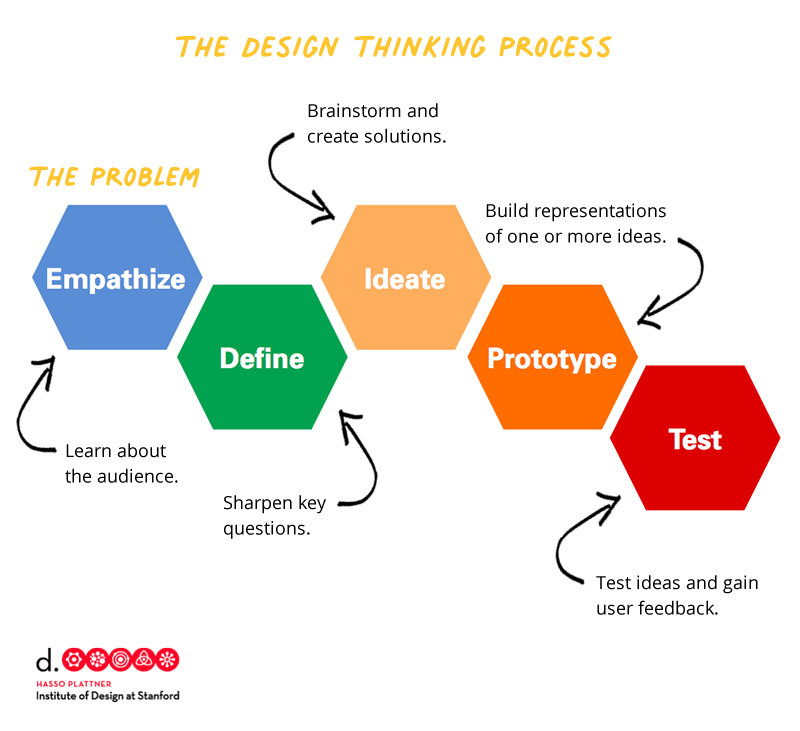
When we map Yik Yak’s development onto the five phases of the Stanford Design Thinking process, we can see that it was either skipped, rushed, or fundamentally misunderstood in almost every single stage.
Empathize
The founders did something that could be labeled as market research, they observed their own campus and its events to understand what students wanted from a social app. This narrow scope gave them an incomplete picture. Questions like: What happens if our app reaches high schools? What does anonymity do to group dynamics under social pressure? Were left unanswered even though academic literature like John Suler’s 2004 paper on the Online Disinhibition Effect, was available, which directly related to their product.
Define
The wrong problem was defined as: How might we create an anonymous, hyperlocal community platform for college students? When instead the real question should have been: How can we enable a psychologically safe, anonymous local communication for a diverse set of user groups?
This false framing led to the Yik Yak as it was built, as the second question would have resulted in a fundamentally different set of design restraints, which might have prevented the worst outcomes.
Ideate
The upvote/downvote system, which is a good idea on paper, because the users self-regulate, has one big flaw. The users need to be both willing and able to do so. For it to work harmful content must be in the minority, but when most of the community uses the app to increase harassment rather than stopping it the mechanism breaks.
There is no evidence of the founders ever seriously exploring misuse scenarios. The question “How might this go wrong?” was never asked with the same importance as “How might this grow?”
Prototype
Furman University, a small predominantly white liberal arts college was the first to get the prototype. From there on it spread virally to Georgia Tech and schools beyond, but this was not a deliberate prototype test on a representative sample. The problem was that this organic growth was mistaken for validation.
The prototype phase should have normally exposed the tensions in the product. Instead, the first test community was so homogeneous, it masked these problems. In a representative prototype phase, across different campuses, age groups and demographics, the risk would have surfaced before it became real.
Test
Because the prototype phase was so narrow, a real test phase never really happened at all. Real users unwillingly became the test group. Geo-fencing around schools was only introduced after problems emerged. Content filters came after controversies escalated and usernames were made mandatory in 2016 after the user base had already collapsed. Every change came too late and changes like the mandatory username even destroyed the core value of the product.
Li and Literat (2017), in their peer-reviewed analysis of Yik Yak’s ethical failures, argue that the platform’s problems were not primarily a misuse problem but a misdesign problem, the harmful outcomes were foreseeable consequences of deliberate design choices, not aberrations. The real users were the test. And they paid the price for it.
Root Causes of Failure
Organizational
Two young, inexperienced founders solved their own problem and scaled it without the needed organizational structures like a trust or safety team or an ethics function. Money raised like the $60 million by Sequoia Capital was spent to accelerate growth and not to fund governance.
Technological
Anonymity was implemented as an absolute and not as a design parameter. There was no mechanic for accountability. The downvote system was not a proper moderation system but rather a popularity contest under the name of content governance.
Cultural
Yik Yak was a product of the “move fast and break things” era of Silicon Valley, where societal impact was not a metric of products. Growth metrics were valued more than real human outcomes.
Ethical and societal
The Online Disinhibition Effect was a widely known phenomenon and the research on cyberbullying and harassment was extensive. Nonetheless Yik Yak’s founders did not engage with it and treated the ethical dimensions of their platform as someone else’s problem only addressing them as they became unavoidable.
Redesign Proposal
A redesign proposal for Yik Yak is not about different features but mostly about a different process that sees ethical and social impact as a design constraint and not a cleanup problem after launch.
Empathize
At the beginning the team should have conducted research across a diverse set of communities. They should have focused on urban and rural campuses, high schools and universities and majority and minority student groups. “Extreme users” should have been included from the beginning, because they are more likely to misuse or be harmed by the product than typical users. School counsellors as well as anti-bullying researchers should have been part of the empathy phase already, instead of being called after the crisis.
Define
A multi-stakeholder group should have co-created the problem statement with them. An ethical Design Canvas in this stage, mapping who might be harmed and how, would have surfaced tensions between anonymity and accountability before becoming a crisis.
Ideate
In the Ideation phase they should have included dedicated sessions with a clear goal on finding ways how the product could be abused. How might someone use the app to threaten others? How might a group abuse and weaponize the upvote system? These questions might seem paranoid but should be part of a responsible design process.
Prototype
Rather than only releasing the app to a single, homogeneous campus and seeing the viral spread as validation, a responsible prototype would have been tested on a diverse set of users. Different campus types and demographics. Especially younger users, who would eventually find their way onto the platform. The goal of a prototype is to discover where it breaks, not to confirm that the product works.
Test
The test phase should have been structured instead of accidental. A proper test should have included clear metrics for what counts as harmful content and explicit escalation protocols for threats. Most importantly the test phase should have included simulated crisis scenarios: What happens in case of a shooting or bombing threat? Who is responsible? Instead, these questions were answered in real time, by real institutions and real consequences. A proper test would have made them hypothetical.
A real Design Thinking process might not have built Yik Yak at all. The research would have surfaced that there is not a lack of anonymous communication, but a lack of safe anonymous communication. This would have led to a different product. A semi anonymous platform with verified campus accounts, institutional partnerships and accountability mechanisms. An app anonymous to peers, but not to administration in case of credible threats.
Lessons Learned
Droll and Buffington were not bad founders, they were creative, technically capable and believed in their problem. Their failure results in the lack of asking the uncomfortable questions during their design process.
- Anonymity cannot simply be treated as a feature because it is an ethical commitment that influences all other design decisions
- Empathy research can not only include the intended users like market research does. These two are not the same.
- Structural safety mechanisms need to be included because community moderation only works in healthy communities
- Simply not knowing is not an adequate defense when the evidence was available the whole time. Designers are responsible to engage with what is already known about a product/topic
- Reactive iteration is not agile development. It is damage control. Design Thinking has the goal to surface problems before they occur not to fix them after they happened.
The most important lesson we can learn from Yik Yak is that good design is not only about solving the user’s problem. It is about which problem you are actually solving, for whom and at whose expense.
References
Li, Q., & Literat, I. (2017). Misuse or misdesign? Yik Yak on college campuses and the moral dimensions of technology design. First Monday, 22(7). https://doi.org/10.5210/fm.v22i7.6947
Suler, J. (2004). The Online Disinhibition Effect. CyberPsychology & Behavior, 7(3), 321–326. https://doi.org/10.1089/1094931041291295
Kolodny, L. (2017, April 28). Yik Yak shuts down after Square paid $1 million for its engineers. TechCrunch. Retrieved April 20, 2026, from https://techcrunch.com/2017/04/28/yik-yak-shuts-down-after-square-paid-1-million-for-its-engineers/
Failory. (2023). Yik Yak’s shut down: Why did the location-based app fail? Retrieved April 20, 2026, from https://www.failory.com/cemetery/yik-yak
EM360Tech. (2024). Why did Yik Yak fail? How the messaging app died. Retrieved April 20, 2026, from https://em360tech.com/tech-articles/why-did-yik-yak-fail-how-messaging-app-died
Figure 1: Yik Yak Logo. Zeit Campus. Retrieved April 20, 2026, from https://www.zeit.de/studium/uni-leben/2015-03/yik-yak-mobbing-usa
Figure 2: Stanford Design Thinking Model, makedohub, Retrieved April 20, 2026, from https://hub.make.do/education/steam-design-challenge/design-thinking-process