
The High Cost of Skipping Empathy: Why the Virtual Boy Was Dead on Arrival
Have you ever wanted to play a video game through the periscope of a submarine? Nintendo offered the chance to experience it first-hand” [S1]. That is the hook I wish I came up with myself, instead I ehm… borrowed it from the brilliant article “Looking Back at the Virtual Boy, Nintendo’s Most Famous Failure”. The phrase just perfectly captures what so many people disliked about Nintendo’s Virtual Boy, a first attempt in 1995 to bring some sort of Virtual Reality to the public. But was it really as bad as critics argue and could a healthy Design Thinking process have actually made it the next big thing? Let’s find out!
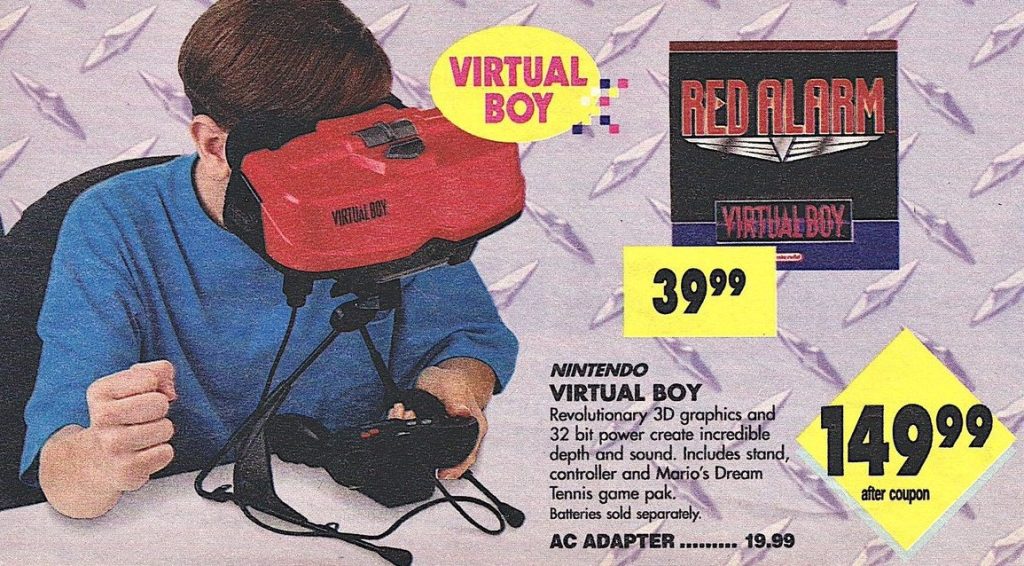
“Nintendo Virtual Boy – 3D Console”, P1
Problem Context
So what problem was the Virtual Boy actually trying to solve? To answer this question we need to take a look at the inventor of the device: Gunpei Yokoi. He was one of Nintendo’s biggest creators having invented the Gameboy and even the D-pad, yes the cross-shaped button you find on almost every controller nowadays. However, in the 90s he felt out of touch with the industry he once loved. All the big players like Sony, Sega and also Nintendo were focusing on bringing out consoles with better and better graphics [S2]. Yokoi didn’t want to be part in this race for performance. He wanted to compete on “the battlefield of ideas” and provide the players a completely new and immersive experience. He argued people would soon get bored of regular screens and 3D could be the only next step for gaming [S3].
While this seems like a valid point at first, some of you might already notice what could be the issue here. Yokoi didn’t start with the user, he simply made the assumption that soon enough people would get bored of regular screens and 3D technology would be the only remedy for that. With relatively cheap 3D technology available, Yokoi followed a solution first and technology driven approach that wasn’t based on empathy for users.
The stakeholders
In the 90s, VR was receiving the public interest for the very first time [S4]. But instead of asking the people what they wanted, Nintendo started with a piece of technology: the Scanned Linear Array (SLA). It was a display system invented by Reflection Technologies that used an array of LEDs and a rapidly moving mirror that could simulate a 3D effect relatively cheap [S5]. The goal was a 3D headset with head tracking [S5]. Other companies like Sega and Hasbro didn’t approve of the SLA since it only used red LEDs. On the other hand, Yokoi loved the pitch that Reflection Technologies gave Nintendo because their product complied perfectly with his principle “Lateral Thinking with Withered Technology” [S2].

“Mario Tennis Gameplay”, P2
Nintendo director Hiroshi Yamauchi also approved the pitch by… falling asleep. No, seriously! In the Japanese business world this means the boss trusts the idea because he doesn’t need to oversee it [S4]. However, Nintendo’s management had a completely different angle. With Sony and Sega releasing 32-bit consoles in 1994 and the Nintendo 64 not arriving until 1996, they needed a gap-filler. And with most of Nintendo’s resources focusing on the development of the Nintendo 64, the Virtual Boy was only the second priority [S4].
Another big problem was that the intended users didn’t like the product and people who enjoyed it were scared away from health warnings. This left not a lot of actual users. Let me explain that! Nintendo aimed the console at hardcore gamers since the red only graphics would probably scare regular people away. However, the console was shipped without a single killer title and with the underwhelming red-only graphics. Designated Nintendo fans didn’t like that, they expected the next version of the Game Boy. The “hardcore” gamers, who were the original target customer group, were missing the great games like Mario or Zelda they were used to from the regular Game Boy [S5].
In 1996, one year after the release, Yokoi even claims in an interview that regular people and kids actually enjoyed the Virtual Boy a lot. Yokoi says that if Nintendo marketed the Virtual Boy as a toy for non-gamers it would’ve been more successful [S5]. However, there were rumors going around that the Virtual Boy might hurt people’s eyes and lawyers insisted on putting many health warnings on the product. This scared concerned parents away, effectively making the Virtual Boy unavailable to their children who apparently liked playing with it [S3].
Just from looking at the different stakeholders, we see many conflicting needs. Management needed speed, lawyers needed compliance, players needed great games and parents needed safety for their children. None of these were ever balanced against each other. But why? What went so wrong in the development process of the Virtual Boy?
Design Thinking Breakdown
Design Thinking is most often defined in five stages: Empathize, Define, Ideate, Prototype and Test. Importantly, that is not a linear process. Often it takes many iterations of some or even all phases until you finally come up with a viable product [S6].
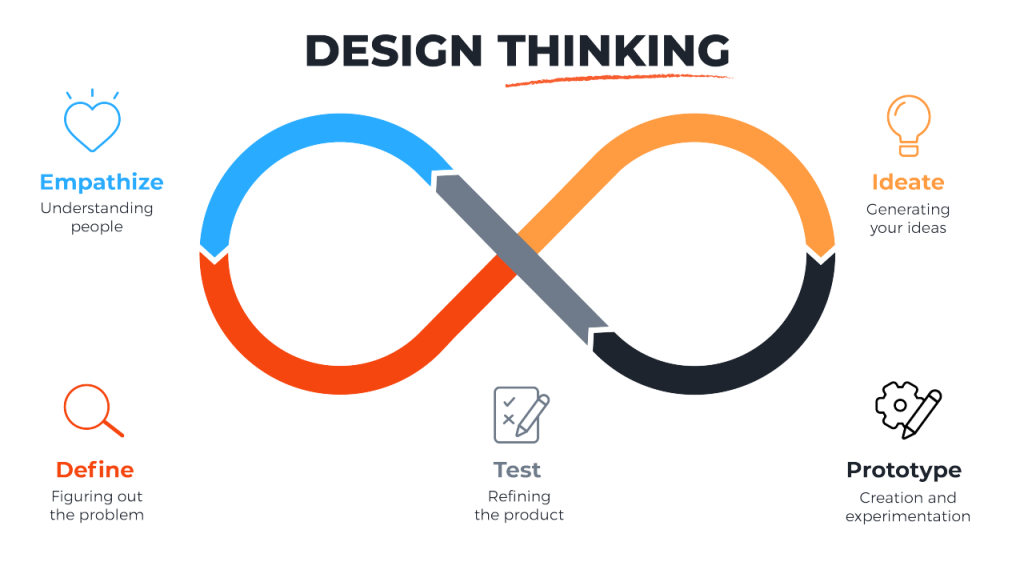
The Five Stages of Design Thinking, P3
Empathize and Define – Skipped
So in a healthy Design Thinking process, you define a problem after thoroughly empathizing with real users by conducting interviews or by simply observing them in their natural environment. Only then, once you have defined a clear problem you look for solutions. We already noticed that Nintendo did the exact opposite. They didn’t start with the users at all, they started with a Scanned Linear Array and worked backward from there. Yokoi didn’t observe gamers struggling with 2D screens, he simply decided that since 3D tech was now available it would be the next big thing. From a Design Thinking standpoint, this is a cardinal sin, as the Empathize and Define stages were effectively skipped. Yokoi simply stated the problem that gamers required a more immersive 3D experience [S7]. And yes the excitement for deeper immersion wasn’t completely made up, but excitement is something fundamentally different from validated user needs.
Ideate – Rushed
In a standard Design Thinking flow the Ideation phase is where you go crazy. You throw in as many solutions as possible. Counterintuitively, it’s all about quantity and variety before you can commit to quality. Afterwards, you build prototypes of your ideas and then show them to real users, so that you can see which idea works and what needs to be improved by iterating through the process again [S6].
Nintendo skipped all of that. They only had this one technology driven idea and went all in on it. Design Thinking is not only about solving the right problem, but also about solving this problem right. That’s why, Ideation is supposed to explore multiple possible solutions, not lock one in early [S6]. By committing to a single concept from the beginning, Nintendo skipped the opportunity to compare alternatives. Only relying on one idea is a big gamble because what do you do when it turns out there are a lot of issues with your one idea? They were about to find out!
Prototype – Constrained
While developing the Virtual Boy Nintendo ran into several problems. Remember originally it was supposed to be wearable headset with head tracking that creates the illusion of VR. However, with the introduction of a very strict consumer protection law in Japan, companies were now responsible when a customer experiences any harm because of using their product. Nintendo’s lawyers had nightmares about kids falling down the stairs while moving around with the headset. This resulted in the prototype being a static console that had to stand on a table [S5].
Moreover, there was a wide spread rumor that the Virtual Boy could cause eye damage. That’s why Nintendo hired Dr. Eli Peli of the Schepens Eye Institute to make a scientific evaluation. The result was that the device was mostly harmless. Only if the two displays were misaligned, young children with not yet developed eyes could develop a lazy eye [S2]. However, the new laws were so strict that lawyers still insisted on painting the product box with health warnings, ultimately scaring many concerned parents.
Test – too late
Nintendo first showed the product to the public in November 1994 on the Shoshinkai trade show [S2]. The public could try the product for the very first time and the feedback was already underwhelming. The testers were complaining about the lack of head tracking, the staticness of the device, the red color and there were even the first people complaining about headaches [S5]. Unfortunately, at this point it was too late to make any major changes because the Nintendo management was eagerly pushing the release date and too much resources already went into the development. That’s why the very negative first impression of the public could not really be addressed through iteration.
Also a former Nintendo employee Jim Wornell described the internal tests that did take place as inhumane. He even compared them to a scene from ‘A Clockwork Orange’ (if you dare google it). Wornell recalls it as “inhumane torture tests” that included dilating his pupils multiple times, blowing air into his eyes and even plastic rods touching his eyes [S8]. These tests don’t really sound like they were aimed to collect data about user experience. It sounds like Nintendo only cared about the product not physically hurting anyone. The result was unsurprising…
Root Causes of Failure
The Virtual Boy arrived in July of 1995 with a price tag of $180 and a promise of revolutionary 3D gaming. Instead, it became a huge flop only selling 770.000 units in the USA and Japan combined [S7].
From an organizational standpoint, the Virtual Boy was running on leftovers. Nintendo’s main resources were focused on the Nintendo 64, so that only 22 games were released for the Virtual Boy. Fans complained that there was no real “Killer Game”, no Mario, no Zelda and also most games didn’t take advantage of the 3D property [S2]. Overall, there was no game that made the relatively expensive hardware worth it to most Nintendo fans.
The technological issues were just as bad. The once promised wearable headset got ripped apart. A device was shipped that had no head tracking, used only red LEDs, caused headaches for some people and also stood on a weird tripod that forced you to awkwardly lean your head into the device [S2]. The technology was supposed to cause a “WOW” effect, instead it was more like a “WOW, take this off me”.
Finally, from a societal and cultural perspective, gaming was always something social. People play together, watch and chat with each other. The Virtual Boy cut all of that off. You stuck your face into a box and disappeared from the room. If that didn’t scare parents off then the health warnings did.
The Redesign
Many of these causes for failure could have been solved if Nintendo had applied a proper Design Thinking process that integrates real user feedback through iterations instead of sticking to the plan no matter what.
In a successful empathize phase, the team would interview different customers and ask them what is missing for them with current products. Ideally, they could even observe people’s actual gaming behaviors in their preferred environments. Often it also helps to watch extreme users [S6]: in our case designated gamers and people who have never touched a controller before. By observing different users at home or even in arcades, they would discover a few key needs: people enjoy the social aspect of gaming, they value comfort and ease of use and they want to play games they already love. They would also notice that gaming is often done while sitting or lying in a relaxed position and not leaning forward into a device.
Based on these findings the Nintendo team could’ve defined a more fitting problem statement like “Players want a more immersive way to experience games while still being able to enjoy the other aspects of gaming like social interactions and great games”. This changes everything, as the focus moves from a pure technology push toward a more balanced, human-centered approach.
In the ideation phase, the focus should be on discovering lots of different ways to tackle the now human centered problem. Nintendo could hold structured brainstorming sessions including Stoke activities like making weird sounds while passing an imaginary ball around or you know… Post its [S6]. Either way, I’m sure that Nintendo’s creative minds would produce dozens of ideas to make gaming more immersive while maintaining other qualities of gaming. Surely, the stereoscopic 3D technology would be one of the ideas but they would have also generated alternatives like TV-based 3D systems or even a handheld 3D console.
In the next phase, these ideas are turned into quick and low-cost prototypes. To test a prototype for the tabletop console, some cardboard, duct tape, two Scanned Linear Arrays and a basic game would be sufficient to explore how users feel, what they do and don’t like. Just imagine this scenario: a developer watches a teenage Nintendo fan play the prototype, he keeps pausing the game and hands the device over to his friends sharing what is happening. His friend says: “Why can Mario only play Tennis, this isn’t a real Mario game!” Ok in actual interviews, these insights are not delivered to you on a silver platter like that. It usually takes a lot of questions, putting yourself in the user’s shoes, paying attention to little, even non-verbal things like a player massaging their back after playing [S6]. Ultimately, the tests would reveal the flaws the design had: discomfort from posture, lack of social interaction and the rejection of the red-only visuals. What could follow are more iterations to add things like local multiplayer or a better tripod. Most importantly there should be more prototypes for different ideas and all problems would appear in the very beginning of the process, when they can still be fixed by iterating through the Design Thinking process. And if an idea keeps failing in testing, you can always drop it, because you came up with many more during ideation.
The lesson
If Nintendo had embraced a true Design Thinking mindset, the neck pain, the red-only visuals and the isolation wouldn’t have been failures at the launch. They would have been datapoints in a prototype and testing phase. By testing different ideas early, they could have changed directions without great cost. Even when legal hurdles blocked the wearable headset, iterations and different ideas could’ve led to completely different products such as 3D screens. You could even argue that the Virtual Boy wasn’t a failed console at all, but just the world’s most expensive prototype testing from which eventually the Nintendo 3DS emerged. The Virtual Boy is a classic reminder that great inventions can sink like a submarine if it ignores the person behind the periscope. Okay, maybe that one sounded better in my head. Anyways, here are the three final takeaways for all of you that made it to the end:
Start with the user, not the technology
The Virtual Boy was an incredible invention for the time, but it failed as an innovation. There is a massive difference between the two. An invention is just something new, an innovation is a solution that is actually viable and provides value to the user. This makes it so important to first deeply empathize with users before falling in love with one solution.
Test early, fail cheap
The problems that Nintendo encountered weren’t unfixable, they simply showed up too late. A headache discovered in a prototype phase costs nothing since you could fix that through iterations. A headache discovered at launch however costs you everything. If Nintendo had tested rough prototypes with users early, things like the neck pain or the headaches would’ve been information and not reasons to fail.
A deadline is not a design process
The Virtual Boy was basically a prototype sold as a finished product which was because of the strict deadline set by management. Speed is good, shipping something unfinished is not. Yokoi said himself that he didn’t want the product to come out like this [S5].
Bibliography:
[S1] “Looking Back at the Virtual Boy, Nintendo’s Most Famous Failure.” IGN. https://www.ign.com/articles/looking-back-at-the-virtual-boy-nintendos-most-famous-failure
[S2] “The Red-Black Legacy of Virtual Boy.” Virtual Reality Society. https://www.vrs.org.uk/red-black-legacy-virtual-boy/
[S3] “Yokoi / Xeno Interview.” Shmuplations. https://shmuplations.com/yokoixeno/
[S4] “Turns out the History of the Virtual Boy is More Interesting Than the Console Itself.” Nintendo Life. https://www.nintendolife.com/news/2016/05/turns_out_the_history_of_the_virtual_boy_is_more_interesting_than_the_console_itself
[S5] “Seeing Red: Nintendo’s Virtual Boy.” MIT Press. https://direct.mit.edu/books/oa-monograph/5781/Seeing-RedNintendo-s-Virtual-Boy
[S6] “5 Stages in the Design Thinking Process.” Hasso Plattner Institute of Design (d.school), Stanford University. https://dschool.stanford.edu/tools/design-thinking-bootleg
[S7] “Nintendo’s Virtual Boy Disaster: Key UX Lessons for Product Managers.” Product Coalition. https://medium.productcoalition.com/nintendos-virtual-boy-disaster-key-ux-lessons-for-product-managers-fde602e92736
[S8] “Nintendo’s ‘Inhumane’ Virtual Boy Testing Process Likened To ‘A Clockwork Orange’.” Nintendo Life. https://www.nintendolife.com/news/2022/02/nintendos-inhumane-virtual-boy-testing-process-likened-to-a-clockwork-orange
Pictures:
[P1] “Nintendo Virtual Boy – 3D Console”, The Old School Game Vault, https://theoldschoolgamevault.com/blog/articles/986-nintendo-virtual-boy-3d-console
[P2] Mario’s Tennis. Screenshot, Virtual Boy (1995). VG Museum. https://www.vgmuseum.com/end/vb/a/marioten.htm
[P3] “The Five Stages of Design Thinking.” LinkedIn. https://www.linkedin.com/pulse/five-stages-design-thinking-raghav-balasubramanian-ms9kc
All sources were last accessed 20.04.2026.