
By now, everyone has seen at least one video filmed with smart glasses. It could have been a funny prank, maybe it was an impressive sports stunt or perhaps something completely different. If at any point during the video you thought to yourself “Wait a second, how are they even filming this while using both of their hands?” then the answer was most certainly: Smart glasses. They are the new evolution of POV filming and the next logical step in our technology-driven world. But what if I told you that this invention is not new at all? Would you be surprised to learn that smart glasses were first introduced more than a decade ago?
When Google revealed Glass, the first commercially relevant smart glasses, in 2012, they caused a worldwide commotion. Now, more than a decade later, many people cannot even remember the product’s existence.
Join me on a journey back in time to find out why Glass failed and how Google could have utilized the concept of Design Thinking to their advantage, to revolutionize the smart glasses market then, instead of trying to catch up to it today.
Problem Context: Does innovation constitute interest
While many people nowadays immediately connect smart glasses to taking videos in first person, Google Glass had a much bigger vision. The goal was to completely replace the smartphone, envisioning a future where the capabilities of a handheld device were seamlessly integrated into their wearable interface.
Framed as removing “heads-down” smartphone usage for a new “heads-up” approach, this was supposed to result in a “less disruptive” and more “socially involving” use of technology.
However, as we will later find out, a combination of critical design flaws and misguided marketing eventually led to the glasses achieving the exact opposite.
What we have here acts as a perfect example of a so-called technology push. It is clear that the only problem the public had with the “heads-down” culture was the general idea of being distracted by technology in an environment where you should instead focus on your fellow man. Thus, there was no real demand for a different technological product that would be used in a public space (which is how it was marketed) and distract you from the people right in front of you too.
A technology push is when you first develop your product and then try to find a market for it, which acts as a direct opposite to the Design Thinking approach. Clearly Google tried to manufacture a problem for their product to solve, without this problem really even existing.
Stakeholder & User Analysis: Creating a product for the wrong customer
When we look at the initial concept video “Project Glass: One Day”, we can see that the intended target for the product was a wealthy, tech-interested middle-aged man.
However, after diving deep into Glass enthusiast websites and forums, I came to the conclusion that the only people who eventually ended up using Google Glass for a longer duration of time strayed far from this intended customer. People interested in hiking, athletes and occasionally filmmakers all used the glasses for one sole purpose: Getting cool POV shots without having to hold a smartphone.
This target audience is generally not interested in the technical aspects of the product but rather in the practical use it delivers, which created a strong contrast between what Glass wanted to be and what the people wanted to use it for. An overloaded tech gadget versus an easy-to-use POV camera.
Meanwhile there is a whole different group of potential customers which was completely overlooked. Partly, because it was not as present then as it is now and partly, because it too does not count towards the tech bubble.
I am of course talking about independent creators and influencers.
Nowadays we see an immense rise in people trying to make it on social media. Almost everyone and their cat has a social media account where they are posting photos and videos on.
Especially on TikTok, Instagram Reels and YouTube Shorts you regularly come across teens to early adults who are using Meta Glasses to film themselves doing something funny or interesting in public, proving that there was in fact a market far outside the tech bubble, which Google failed to identify and subsequently cater to.
These people not only want a camera that is operable without hands, they also want it to be discreet. When visually comparing Glass to Meta Glasses the former looks like something a Star Trek character would wear while the other might as well just be an ordinary pair of sunglasses to the uninformed eye. So, while this could be a tech nerd’s dream, someone trying to raise as little attention as possible has no use for the product.
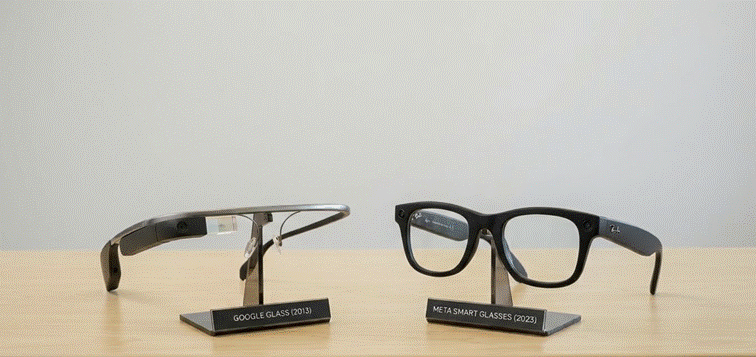
(AI-generated image using Gemini showing both products next to each other for visual comparison)
We are going to circle back to the Meta Glasses a few more times during this blog post, because they serve as a great example of what Google Glass did wrong and what they could have done better.
Design Thinking Breakdown
I am sure that at this point every single one of you is burning to know the answer to one question. How did such a big and successful company like Google, with a product that as we know now had the potential to revolutionize the market, manage to drop the ball in such an embarrassing way?
The answer is simple. It can all be traced back to a rushed and sloppy Design Thinking process.
Instead of taking their time to thoroughly go through the different phases of Design Thinking (Empathize, Define, Ideate, Prototype and Testing), Google wanted to push their new invention out into the public as quickly as possible. But, as they had to learn the hard way, when you try to sprint in a marathon, you will inevitably fall behind.
Since we already established that Google did not understand their customer, we can conclude that the first Design Thinking phase: Empathize, which consists of observing your environment to grasp customer demands, was not executed appropriately.
They did not identify the real request for reducing technology in public and instead wrongfully concluded that the problem was only directed towards mobile phones.
This is also the root cause for the following Design Thinking phases failing.
As harsh as it might sound Google was simply unable to solve the problem they were trying to solve. The Glasses turned out to be even more disruptive to normal life than a smartphone ever could.
The culprit, one small but critical oversight in the product’s design, can be identified as the main reason for almost all of the public backlash. Let us take another look at the Meta Glasses, to fully understand what I am talking about.
When filming with the Meta Glasses, a white LED will light up. Because this LED is connected to the hardware, covering up the light will result in the recording stopping. This allows everyone to see whether you are currently recording or not. While this might sound contradictory to the earlier mentioned use case of filming in public, it is precisely the core mechanism that makes it work. Only through the clear ability for others to see whether they are currently being filmed or not the panoptic uncertainty is removed, allowing people to relax when they know they are not being filmed.
The lack of transparency with Glass led to a constant feeling of uneasiness which resulted in the glasses being banned in many private places like cinemas, casinos or even pubs. There are even reports of people getting into physical altercations, because they believed that they were being filmed by another person wearing the glasses.
Instead of creating a seamless user experience the glasses turned out to be majorly disruptive to everyday life for the user, and probably even more, the bystanders. Thus the simple failure to ideate a working solution for this problem made the glasses almost impossible to take out into public.
However, there is also the other possible use case of taking Glass out into nature, cycling, hiking or on a jog, to capture moments on the go, you would otherwise have to take out your smartphone for to record. There is an enormous outdoors community that would have loved such a device, so why did it never reach them? It is safe to say that this can be traced back to a failure in the last stages of the Design Thinking process. The creation and testing of a prototype.
In the case of Google Glass, the first thing that I personally would consider a prototype was the vision they shared in their concept Video “Project Glass: One Day”. When you go back to watch the video, you will notice that it is entirely filmed in first person, presumably with the glasses. But since we are never shown how they look on the wearer, we never get into contact with the main selling point of the product: Supposed seamlessness. Moreover, the video only shows the wearer during calm, day-to-day activities which you could potentially all still use a phone for. Until the end we never see him during any activity where you might really need the glasses, because you cannot capture it any other way.
This would not be such an issue if the public could have just taken the glasses and tried them out themselves. Unfortunately, when Google did release a physical prototype, they only gave the glasses out to selected developers, all of whom were forced to sign strict NDAs. This took away the opportunity for the public to find out more about the glasses and find out what they might want to use them for, which would have allowed Google to adapt to the customers’ real requests, instead of having to operate on what they thought the people wanted.
By keeping the testing circle in a certain demographic, only restricted to developers, Google gravely misinterpreted the last Design Thinking phase: Testing. Through a lack of varied feedback which itself can be attributed to the lack of diversity in the testing group Google robbed themselves of the opportunity to prevent or at least solve many of the issues the product was facing.
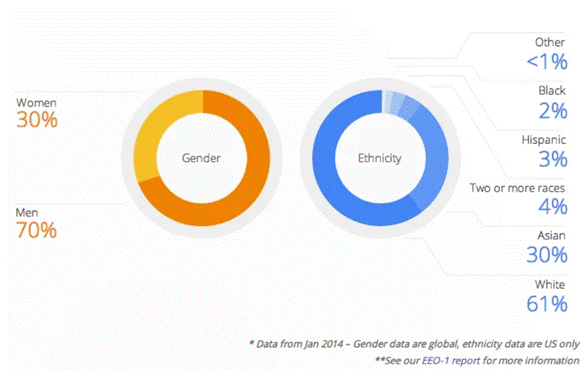
(Google diversity report from 2014. Showing gender and ethnic diversity in Google employees at that time)
Root Causes of Failure: We fear what we don’t know
When pointing out the mistakes Google made and reevaluating what they could have done better, you cannot forget to mention the huge role the state of the world played in the product’s failure and smart glasses nowadays not sparking nearly as much of an outrage as they did back then.
While it is considered more or less common knowledge that we are constantly being spied on by governments and private companies alike, the perceived privacy back in 2013 when the Glass Explorer Edition first launched was completely different.
It was in fact June 2013 when famous whistleblower Edward Snowden initially leaked to the world how the government is spying on its citizens, straining everyone’s relationship with privacy.
As a result, society in the following years, was very sensitive regarding privacy concerns. So it is only natural that the possibility of constantly being recorded without someone’s knowledge put a lot of people off.
When people wearing Google Glass, whom Google called “Glass Explorers”, were approached by strangers and urged to stop filming them, a common counter response was to mention the short battery life of the camera in the glasses: “These cameras can only really film for about 30 minutes anyway, don’t worry”.
Instead of being able to point to the design of the glasses by saying something like: “Don’t worry, you can see if I record you because this light will always be on”, the Explorers were forced to explain the technological issues to try and pacify people concerned about the ethical issues(like being filmed). This alone should have been a glaring indicator to Google that their design was fundamentally flawed.
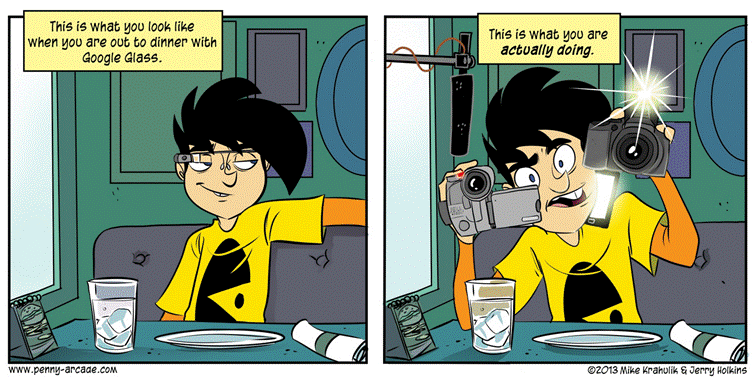
Instead of redesigning the product to ensure that everyone can confidently identify whether they are being filmed or not, Google ultimately shoved the responsibility onto the user by releasing a behavior guide for Glass wearers. It was called “Don’t be a Glasshole” and it included rules of etiquette for the wearer to follow if you wanted to prevent being a “Glasshole”.
To top it off, the issue exceeded past the wearer being able to record other people without their knowledge. Logically, Google was also able to see what the wearer saw without his.
Moreover, Google failed to solve a notorious issue inherent in new technological advancements. With every new invention people first have to explore capabilities, boundaries and social norms regarding its use.
Whenever disruptive technology is introduced to society it is hard to immediately determine a clear set of socially acceptable and unacceptable behaviors. Take electric scooters for instance. When they were first introduced everyone would leave them scattered along the sidewalk. Nowadays people will neatly put them out of the way where they do not block pedestrian traffic anymore.
Under an older YouTube Video about Glass one person commented:” I remember how irritating it felt in 1990 when some self-important person with a Motorola Brick would decide to call someone while waiting in line at the grocery. The GlassHole onslaught: 50x as intrusive.”, perfectly encapsulating the predominant social opinion at that time.
Society needed time to identify where you could wear smart glasses and where you should refrain from wearing them simply due to manners. Glass did not survive this Cultural Lag.
So, is that the end? Was Google doomed from the start? Did they have to fail, get the ball rolling, so that other companies like Meta could reap what Google sowed?
We can never be sure, but there are definitely areas where Google could and should have acted differently, even though some mistakes probably had to have been made, so that other companies could learn from them.
Redesign Proposal: From Cyborg to Human
Since we already established why many of the problems the glasses faced originated from rushed early Design Thinking phases, I believe Google would profit substantially from restarting their whole Design Thinking process at the beginning, reevaluating what the people really want and identifying how they can shape their product to fit these demands.
To understand the need for an indicator for recording, Google should have initially prioritized the Empathize phase of the Design Thinking process, giving it sufficient time and putting a larger focus on observing their environment. By correctly identifying the non-technology-interested population as a key stakeholder for their product’s success they then could have conducted surveys, interviews and even acceptance tests with small prototypes, to find out how this group would react towards the new technological disruption to their everyday life. Giving them an opportunity to integrate countermeasures into the design from the beginning.
In the Define phase Google made the mistake of trying to find a persona to which their technology fit instead of first defining multiple personas that might have an interest in the glasses and then proceeding to develop the glasses with the needs of those personas in mind. As a company you should never let the excitement about a new invention carry you away to the point where you just assume that the sheer impressiveness of this novelty will automatically attract the customers’ attention. In reality, society is heavily living in bubbles. Most of the time people will not even notice something if it is not directly related to their interests. To reach a bubble you almost always have to tailor your product to match their specific needs. Only by defining these groups in an early stage do you enable yourself to implement these changes with minimal effort and cost.
Apart from the obvious addition of an indicator for recording, Google would most certainly have concluded that they need to overhaul the optical design of the glasses as a whole. Instead of releasing a singular look, only catering to the techy audience, they would have designed several looks. One for day-to-day use, just looking like glasses, another that is a little bit more robust and sits firmly on the face for people looking to film their sporty achievements.
Embedding different affordances into each design would automatically convey the different use cases, thus attracting a much broader audience. A side effect of more people coming into contact with the product and therefore being more informed about what it can and cannot do is that it would stop being a black box for the people. Consequently, the mere-exposure-effect would organically reduce the initial social stigma against the glasses and lead to widespread habituation.
To get this to work Google would have also needed to change their approach to the later Design Thinking phases by creating more attractive, accessible and affordable prototypes while simultaneously shipping them to a more diverse clientele for more diverse feedback. It would have been necessary to take the financial hit this may have initially created to guarantee future success for the product.
Nonetheless it may be difficult to regain a foot in the market now, after brands like Meta were able to establish such a strong base already.
Let us circle back one last time to look at how they and other brands were able to learn from the mistakes Google made, releasing smart glasses while averting those same backlashes Google had to face in the decade before.
Lessons Learned (Hopefully)
A classical characteristic of a technology push like Google Glass is the urge to dump as many features as possible into your new product without consideration for what is actually fitting and what would bloat it.
During their Define phase Meta in cooperation with Ray Ban did a noticeably better job of identifying which features they really needed, which is why their glasses initially did not contain a little computer like Glass but instead exclusively acted as a POV camera and fancy headphones. Only years later did they ease the new features in, releasing newer models that offered more advanced capabilities.
The key here is to start slow and then take up the speed. Once your product is established, meaning people are already using it in various ways, thus removing the negative stigmas commonly connoted with new technology, you can go ahead and offer additional features.
By now I have mentioned how Meta introduced the visual indicator for recording several times already. Not only does it appease the bystanders, because they can see when the recording is on but its connection to the hardware of the glasses, which makes it so that you are incapable of covering the LED without the recording stopping, creates a feeling of trust towards the company. It makes it seem as if they do not intend to record you without your knowledge, simply because they build their product in a way that makes it impossible to do so.
What we see here is the direct result of a correctly executed Empathize phase: By truly understanding the stakeholders’ biggest complaint with Glass, Meta was able to define the problem and successfully ideate a hardware solution to solve it.
In the end the heavy critique about Glass helped other brands like Meta to do it better. You will never know what percentage of the population wants to look like a Cyborg until you give them the opportunity to.
If you decide to take a look at the currently available models you will not only find “regular” glasses. Meta also has a model with Oakley for sporty people, and they market their product accordingly, to reach this outdoors community. After all, even with the greatest idea, what people will buy from you is what you show them. With your prototype looking like it came straight out of a sci-fi movie no one will think of using it to record their next hike. If it looks like cycling glasses however, similar use cases become much more apparent.
It is always easy to find improvements after the fact, but it is much harder to keep an eye on everything when you are in the process of creating your product with your mind wrapped up in other things. This is exactly where you profit most from Design Thinking, because it ensures that you still put enough time and thought into the foundational stages, avoiding the pitfalls Google faced.
But who knows? Google is trying again with the Android XR Glasses. Do you think they have learned their lesson, or will we meet again three years from now for a rewrite of this post, just with a slightly different title?
References:
Domus: https://www.domusweb.it/en/design/2013/08/07/supernormal_googleglass.html#:~:text=Glass%20advocates%20claim%20that%20its%20heads%2Dup%20display%20will%20actually%20be%20less%20disruptive%20and%20more%20socially%20involving%20than%20heads%2Ddown%20smartphone%20use%2E
Reupload of the Project Glass “One Day” Video: https://www.youtube.com/watch?v=5R1snVxGNVs
SozTHeo: https://soztheo.de/glossar/panoptismus/#:~:text=Panoptismus%20bezeichnet%20nach%20Michel%20Foucault%20ein%20modernes%20Machtprinzip%2C%20bei%20dem%20Individuen%20durch%20die%20M%C3%B6glichkeit%20permanenter%20Beobachtung%20zur%20Selbstdisziplinierung%20angehalten%20werden
CNET: https://www.cnet.com/tech/services-and-software/google-glass-blamed-for-melee-in-sf-bar/
The mentioned comment can be found below this Video: https://www.youtube.com/watch?v=FlfZ9FNC99k
Image Credit:
Caricature on Penny-arcade:https://www.penny-arcade.com/comic/2013/06/14/glasshole
Google diversity blog post 2014:https://blog.google/company-news/outreach-and-initiatives/diversity/getting-to-work-on-diversity-at-google/
AI-Generated image:https://gemini.google.com Prompt:[Create a picture of Google Glass next to the Meta glasses illustrating how the two products visually differ. Keep the background neutral.]